
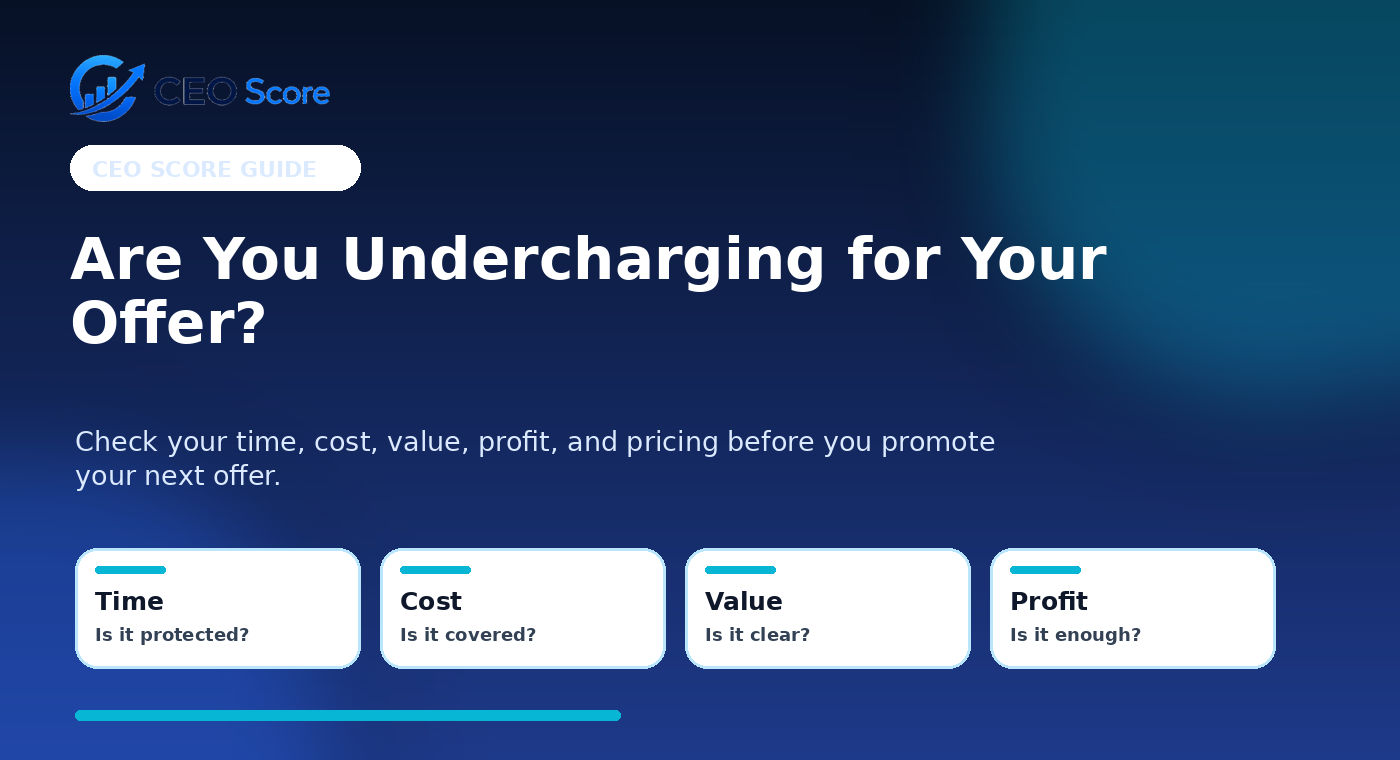
Are You Undercharging for Your Offer?
If your offer is selling but your bank account is still acting suspicious, your price may not be carrying the business behind the work.
Undercharging usually does not start because someone is bad at business. It starts because the price feels safer when it is smaller.
You want people to say yes. You do not want to scare them off. You do not want to sound “too expensive.” So you lower the number, add a few extras, include extra support, answer more messages, do more revisions, and call it being helpful.
Helpful is beautiful. Underfunded is not. If your offer does not cover the real time, cost, energy, skill, and delivery behind it, the business may look active while quietly draining you.
Undercharging can make a business feel busy and broke.
Here is the sneaky part: people may actually buy the underpriced offer. That sounds like a win at first. But if every sale leaves you tired, stretched, or barely keeping anything, the offer is not really doing its job.
Your price is not only paying for the thing the customer receives. It also has to support the planning, communication, tools, fees, prep work, delivery time, revision time, admin work, follow-up, and profit the business needs to keep going.
The Offer Price Check
Before changing your price, review the pieces that decide whether your offer supports the business or quietly drains it.
Time
How many real hours does it take to deliver one sale, project, package, or client?
Costs
What tools, materials, fees, support, contractors, or delivery costs are tied to the sale?
Value
What problem does the offer solve, and how meaningful is the result to the buyer?
Sales Goal
How many buyers do you need at this price to reach your revenue goal?
Signs you may be undercharging.
- You are getting clients, but the money still feels tight.
- You feel relieved when someone buys, then stressed when it is time to deliver.
- You keep adding bonuses, extras, custom help, or “quick little things” without raising the price.
- You avoid checking profit because you already know the math may get disrespectful.
- You need way too many buyers to hit a basic revenue goal.
- Your price does not include admin, communication, revisions, setup, payment fees, or delivery time.
- You keep saying, “It only takes me a little time,” but somehow the little time keeps becoming the whole afternoon.
What to check before changing your price.
1. Check the real delivery process
Write down everything you do before, during, and after one sale. Include planning, onboarding, messages, calls, revisions, admin, delivery, follow-up, and cleanup. The invisible work still counts.
2. Check your direct costs
Direct costs include anything tied to that sale. This may include materials, software, payment fees, shipping, printing, contractor help, platform fees, supplies, or delivery costs.
3. Check your time value
Your time is not free just because you are the person doing the work. If an offer takes ten hours, the price needs to respect those ten hours, even if you enjoy the work.
4. Check your profit margin
Revenue is what comes in. Profit is what stays. If the price is too low, the money may disappear after costs, tools, fees, and delivery time.
5. Check the value of the result
Price is not only based on time. It is also based on the value of the result. If your offer saves time, reduces stress, solves a painful problem, creates clarity, or helps someone grow, the value may be higher than the hours alone.
6. Check how many sales you need
If your price is too low, you may need too many buyers to reach your goal. That creates pressure on your content, lead flow, sales calls, customer service, and delivery. Translation: now the whole business is running on a treadmill.
Step by step fixes.
Step 1: Write down your full delivery process
List everything it takes to complete the offer. If the work happens in your head, your inbox, your calendar, or your “let me just handle this real quick” moment, count it.
Step 2: Add your real costs
Add tools, fees, supplies, materials, contractor help, shipping, platform costs, and anything else needed to complete the sale. Small costs are still costs when they repeat.
Step 3: Calculate your profit per sale
Subtract the direct costs and consider the time involved. This helps you see if the offer is actually supporting your business or just keeping you booked and tired.
Step 4: Create a better package
If the current price is too low, do not only raise the number and hope for the best. Clean up the package. Clarify the outcome. Set better boundaries. Remove unnecessary extras. Add a higher-value tier if it makes sense.
Step 5: Explain the value clearly
A stronger price needs a stronger explanation. Show who the offer is for, what it helps them fix, what is included, what result they are moving toward, and what next step they should take.
Step 6: Test the new price without apologizing
You do not need to perform a courtroom defense every time you share your price. Say the number clearly, explain the outcome, and let the right-fit buyer decide.
Use a prebuilt toolkit so you are not pricing from a blank page.
The Offer Pricing Toolkit gives you beginner-friendly worksheets, pricing prompts, and editable planning tools so you can review your value, time, costs, profit, and pricing scenarios without building the system from scratch.
- Map what your offer actually includes before you price it.
- Check your time, direct costs, and profit pressure.
- Compare pricing scenarios before choosing a number.
- Create a 30-day pricing cleanup plan with clearer next steps.
CEOscore.ai tools that can help.
Use the Offer Pricing Calculator to review your offer price, direct cost, time cost, profit margin, and sales goal. Use the Hourly Value Calculator to see what your time needs to be worth. Use the Profit Margin Calculator to see how much your business actually keeps after costs and expenses. Use the Revenue Goal Calculator to see how many sales you need at your current price to reach your goal.
What to do next.
If you think you are undercharging, start with the Offer Pricing Calculator. Then use the Hourly Value Calculator to protect your working time and the Profit Margin Calculator to see what your business actually keeps.
Once you see the numbers, use the Offer Pricing Toolkit to turn that clarity into a better price, a cleaner package, and a simple plan you can actually follow.
Questions about undercharging
How do I know if I am undercharging?
You may be undercharging if your offer takes a lot of time, has real costs, and still leaves little profit after delivery. You may also be undercharging if you need too many sales to reach a realistic revenue goal.
Should I raise my prices right away?
First check your time, costs, profit margin, offer value, and sales goal. Then decide whether to raise the price, simplify delivery, remove extras, or create a better package.
What if people say my price is too high?
Some people may not be the right fit, and that is okay. Your job is to explain the value clearly and make sure your price supports the business you are trying to build.
Is pricing based only on time?
No. Pricing can include time, cost, skill, value, outcome, experience, demand, delivery, support, and the result your offer helps create.
Which CEOscore.ai tool should I use first?
Start with the Offer Pricing Calculator. Then use the Hourly Value Calculator, Profit Margin Calculator, and Revenue Goal Calculator to check whether the price supports your bigger business goals.
Educational use only. This guide and the CEOscore.ai tools are for planning and clarity. They are not financial, legal, accounting, tax, or professional business advice.