
What to Fix First When Your Marketing Is Not Working
If your content is getting polite likes but not clicks, leads, bookings, or buyers, your business may not need more noise. It may need a clearer path.
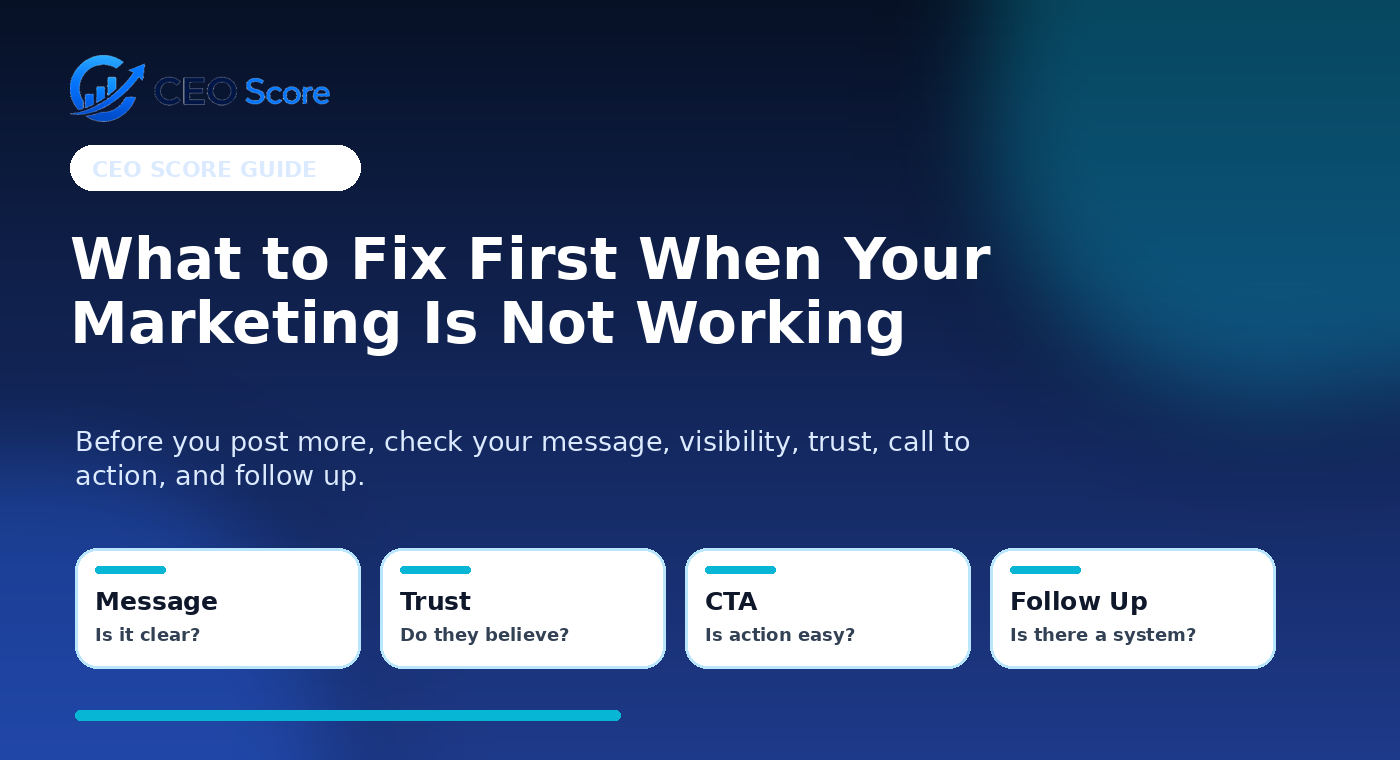
If you are posting, sharing, updating the website, making graphics, trying new captions, and still not seeing clicks, bookings, sales, or real questions, please do not immediately diagnose yourself as “bad at marketing.” That is dramatic, and we are not doing that today.
Sometimes the problem is not your effort. Sometimes the problem is that people can see you, but they do not understand what you do fast enough. Or they understand the idea, but they do not trust it yet. Or they trust you, but the next step is hiding like it owes rent.
So before you create another post out of panic, let’s figure out what actually needs fixing.
Marketing usually breaks in one of four places.
Most entrepreneurs think marketing is one big thing. It is not. It is a path. Someone has to notice you, understand you, believe you, and then know what to do next.
When one part of that path is weak, the whole thing can feel like it is not working. You may be getting views but no leads. Likes but no clicks. Compliments but no buyers. “This is so helpful” messages but zero sales. Cute engagement, but your checkout page is still sitting there untouched.
The Marketing Clarity Check
Before you create more posts or spend more money on ads, check the path people follow when they meet your brand.
Message
Can people quickly understand who you help and what problem you solve?
Offer
Is your offer easy to understand, price, compare, and act on?
Trust
Do people see proof, helpful value, examples, real experience, or a reason to believe you?
Next Step
Is there one obvious call to action they can take without going on a scavenger hunt?
Signs your marketing is not the real problem.
This is where it gets interesting. Sometimes “my marketing is not working” is really “my message is unclear,” “my offer is hard to explain,” or “my follow-up system is nonexistent.”
- You post often, but people do not ask about the offer.
- Your website gets visits, but very few people click, book, buy, or fill out the form.
- People like your content, but they do not become leads.
- Your bio or homepage sounds nice, but it does not clearly say who you help.
- Your offer page explains the features but not the actual problem it solves.
- Your call to action changes every five seconds, so people do not know what matters most.
- You have interested people, but nobody is following up with them consistently.
Use this quick diagnosis.
Instead of asking, “Why is nobody buying?” use a cleaner question: “Where is the path breaking?” That one question keeps you from fixing the wrong thing.
Fix your message before you chase more reach.
Your message should answer three things quickly: who you help, what problem you solve, and what next step they should take. If a new visitor has to decode your business like a mystery novel, they are probably leaving.
A clear message does not need to sound fancy. It needs to land. Try this sentence:
Example: “I help beginner entrepreneurs turn scattered ideas into one clear offer so they can stop overthinking and start selling with confidence.” That is not trying to impress everyone. That is trying to make the right person feel seen.
Then clean up the offer.
A strong offer should not require a whole explanation tour. People need to know what it is, who it is for, what problem it solves, what they get, and what to do next.
If your offer sounds like “custom solutions for growth and strategy,” the reader may smile politely and keep scrolling. If it sounds like “a 60-minute offer cleanup session that helps new service providers explain and price their first offer,” now the brain can actually picture it.
Make trust easier to feel.
Trust is not only testimonials. Testimonials are great, but beginners can still build trust before they have a wall of client wins.
- Show your process so people know what happens after they click.
- Share helpful examples so people can see how you think.
- Use clear photos, clean pages, and updated links so the brand feels alive.
- Add simple proof like screenshots, FAQs, past work, mini case studies, or useful free tools.
- Be honest about who the offer is and is not for.
Stop hiding the next step.
This one is so common. The post is helpful. The page is pretty. The offer is decent. Then the next step is either missing, buried, or competing with six other buttons.
Give people one main action. Take the quiz. Run the audit. Use the calculator. Book the call. Buy the toolkit. Send the message. Join the list. One clear action will usually convert better than five options fighting for attention.
The follow-up is part of the marketing.
Here is the part a lot of people skip: someone can be interested and still not buy today. They might be busy. They might need to ask a question. They might need a reminder. They might need to see the value one more time without feeling pressured.
Follow-up does not have to be weird. It can be helpful, simple, and respectful. A clean follow-up system keeps warm leads from disappearing just because life got loud.
The 7-Day Marketing Reset
Use this if your marketing feels busy but the results are not matching the effort.
Day 1
Rewrite your one-sentence message so it names the person, problem, and result.
Day 2
Clean up one offer page, bio, or post so the next step is obvious.
Day 3
Add one trust signal: example, FAQ, testimonial, process step, or proof screenshot.
Day 4
Choose one main CTA and remove distractions from that page or post.
Day 5
Track clicks, messages, form fills, calls, downloads, or replies instead of only likes.
Day 6
Follow up with warm leads, old inquiries, recent commenters, or people who asked questions.
Day 7
Run the Visibility Auditor and choose the next fix based on what the score reveals.
Keep going
Build a repeatable visibility-to-lead path instead of restarting from scratch every week.
CEOscore.ai tools that can help.
Use the Visibility Auditor to check if people can find, understand, trust, and act on your brand. Use the Lead Conversion Calculator to estimate how many leads or conversations you need to reach your sales goal. Use the Offer Pricing Calculator if the offer feels unclear or hard to price. Use the CEO Score Quiz when you are not sure what to fix first.
What to do next.
If your marketing is not working, do not punish yourself by doing more random work. Start by checking what is unclear. Is it the message? The offer? The proof? The call to action? The follow-up?
Marketing works when the path is clean enough for the right person to move. Your job is not to scream louder online. Your job is to make the next step feel obvious, helpful, and worth taking.
Questions about marketing that is not working
Why is my marketing not working?
Your marketing may not be working because your message, offer, call to action, trust signals, or follow-up system is unclear. More content will not fix a confusing path.
Should I post more if my marketing is not working?
Not always. First check whether your current content clearly explains the problem you solve, points to one next step, and helps people trust your offer.
What should I fix first on my website?
Start with your headline, offer explanation, proof, call to action, and lead capture path. A visitor should understand what you do and what to click next within a few seconds.
How do I know if people trust my brand?
Look for action signals like clicks, replies, form fills, repeat visits, questions, downloads, bookings, and people taking the next step after seeing your content.
Which CEOscore.ai tool should I use first?
Start with the Visibility Auditor if your marketing is not turning attention into action. Start with the CEO Score Quiz if you are not sure whether the real issue is visibility, offer clarity, pricing, productivity, or follow-up.
Educational use only. This guide and the CEOscore.ai tools are for planning and clarity. They are not financial, legal, accounting, tax, or professional business advice.