
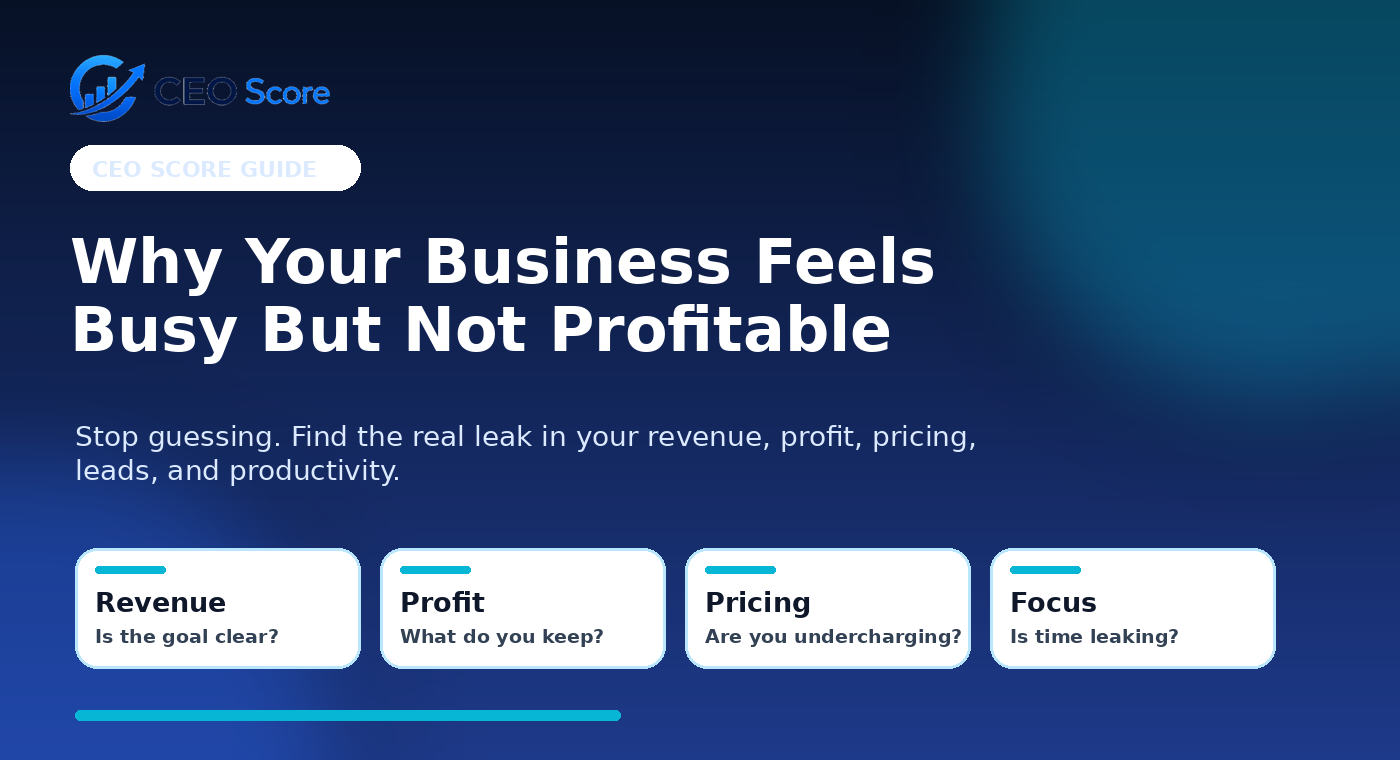
Why Your Business Feels Busy But Not Profitable
You can post, plan, reply, serve, tweak, research, and still end the week asking, “Okay… but where did the money go?”
If your business feels busy but your bank account still feels like it is buffering, breathe. That does not automatically mean you are failing. It usually means your effort is not connected to the right money path yet.
You may be creating content, fixing graphics, answering messages, tweaking your bio, researching ideas, checking emails, serving clients, and doing all the invisible things that make business feel like a full-time group project. The problem is not that you are lazy. The problem is that “busy” can look productive while quietly avoiding the actions that create revenue, profit, leads, and follow-up.
The real issue is usually not effort. It is direction.
A lot of entrepreneurs are working hard. That part is not the mystery. The mystery is whether the work is leading somewhere. If your calendar is packed but your numbers are unclear, your business may be running on vibes, pressure, and caffeine instead of a simple system.
That is why more work is not always the answer. Sometimes “do more” is exactly how you stay stuck. The better question is: which part of the business is actually blocking profit right now?
The Busy But Not Profitable Check
Before you add another task to the list, check the main places where money, time, and energy may be leaking.
Revenue Target
Do you know how many sales, clients, or offers are needed to reach your goal, or are you just hoping the month works out?
Profit Margin
Are you keeping enough after costs, tools, fees, delivery, support, and the little “I forgot about that” expenses?
Pricing
Does your price support your time, value, expenses, and growth, or is it priced to avoid someone raising an eyebrow?
Lead Flow
Do enough people know what you sell, who it is for, and what to do next?
Signs this is happening in your business.
- You work a lot of hours but still feel behind.
- You make sales, but the money seems to disappear after expenses.
- You post online, but the posts do not lead to enough leads or buyers.
- You lower your price because asking for the real number feels scary.
- You have many ideas, but not enough finished offers, systems, or follow-up.
- People show interest, but the next step is not obvious.
- Your day is full of small tasks that feel urgent but do not move revenue.
- You keep wondering which part of the business you should fix first.
What usually causes the busy-but-broke feeling?
1. Your revenue goal is too vague.
“I want to make more money” is honest, but it is not specific enough to guide your actions. Your business needs to know the number. How much are you trying to make this month? How many sales does that require? How many leads do you need to get those sales?
2. Your profit margin is too thin.
Revenue is the money coming in. Profit is what stays after the business pays the cost of delivering the thing. If your costs are rising, your fees are stacking up, or your price is too low, the sale can look good while the margin quietly side-eyes you.
3. Your time is not counted.
Service providers, coaches, consultants, creators, speakers, designers, writers, and virtual support pros do this all the time. They count the call or final deliverable, but not the prep, edits, messages, admin, setup, follow-up, research, or emotional labor of making the client experience smooth.
4. Your offer is doing too much for too little.
Sometimes an offer starts simple and slowly collects extras like a junk drawer. A bonus here. A quick revision there. A “can you also…” moment that never gets charged. That is how a simple offer becomes a profit leak with a cute name.
5. Your visibility is not connected to a buyer path.
Attention is helpful, but attention alone does not pay the invoice. If people see your content but do not understand your offer, trust your value, or know the next step, you may have visibility without conversion.
6. Your productivity is full of low-value tasks.
Not every task deserves your best energy. Some tasks maintain the business. Some tasks grow the business. If your best focus goes to rearranging details while sales, follow-up, pricing, and delivery systems wait until “later,” the business will feel busy but stuck.
| If this feels familiar | The real question | Try this first |
|---|---|---|
| Sales are coming in, but money feels low. | What does the business actually keep after costs? | Profit Margin Calculator |
| You are posting but not getting buyers. | Is there a clear path from attention to action? | Visibility Auditor or Lead Conversion Calculator |
| You work all week but cannot name the win. | Are your hours going to high-value work? | Productivity Score Calculator |
| You are scared to raise prices. | Does the current price cover time, costs, and value? | Offer Pricing Calculator |
How to fix it one step at a time.
Step 1: Find the number behind the goal.
Choose one revenue goal for the month or quarter. Then break it down into the number of sales, clients, appointments, downloads, or offers needed. This turns the goal from “I hope” into “here is the path.”
Step 2: Check what you actually keep.
Look at your most common product, package, or service. Count direct costs, tools, materials, fees, delivery, contractors, travel, and the time that should be included. If the margin is weak, more sales may only create more pressure.
Step 3: Review the price before you blame yourself.
If the offer takes serious time and energy but the price is tiny, the issue is not your work ethic. The offer may need to be packaged, simplified, repositioned, or priced with more confidence.
Step 4: Fix the buyer path.
People should not have to solve a mystery to work with you. Make sure your content, page, bio, and offer answer the basics: who it is for, what problem it solves, what they get, and what to do next.
Step 5: Protect the work that moves money.
Put sales follow-up, offer building, client delivery, pricing review, lead generation, and system cleanup earlier in your week. Do not give your best energy to tasks that only make you feel productive for five minutes.
The toolkit move: stop rebuilding the tracker from scratch.
This is where a lot of beginners waste time. They realize they need to track time, leads, sales, follow-up, offers, and profit, then spend three nights trying to build the perfect spreadsheet instead of actually using one.
The Busy But Not Moving Toolkit gives you prebuilt, editable worksheets and spreadsheet-style trackers so you can find the leak faster. Use it to spot where time is going, which tasks actually move the business, what needs to be finished, and what should stop stealing the whole day.
What to do next.
If your business feels busy but not profitable, do not panic-post, panic-discount, or panic-build another offer at 1 a.m. Measure first. Check the revenue goal. Check the profit margin. Check the price. Check the lead path. Check where your time is going.
Then fix the biggest leak first. That is how the business gets calmer, cleaner, and more profitable without you trying to become 11 people at once.
Questions about feeling busy but not profitable
Why does my business feel busy but not profitable?
This usually happens when daily work is not connected to revenue, profit, pricing, lead conversion, follow-up, or high-value tasks.
Can a business have sales and still not be profitable?
Yes. Sales are not the same as profit. If costs, fees, unpaid time, delivery pressure, or weak pricing are too high, a business can bring in money but keep very little.
What should I fix first if my business is not profitable?
Start by checking profit margin. Then review pricing, direct costs, unpaid time, lead conversion, and productivity.
How do I know if I am undercharging?
You may be undercharging if your offer takes a lot of time, includes many extras, carries real costs, and still leaves little profit after delivery.
Which CEOscore.ai tool should I use first?
If you are not sure what to fix first, start with the free CEO Score Quiz. If you know sales are happening but money feels low, start with the Profit Margin Calculator.
Check what is busy, what is useful, and what is actually making money.
Start with one calculator or the Busy But Not Moving Toolkit. The goal is not to add more pressure. The goal is to find the leak and make the next move obvious.
Educational use only. This guide and the CEOscore.ai tools are for planning and clarity. They are not financial, legal, accounting, tax, or professional business advice.